
Hallmarks
The Dutch hallmark
If assaying shows that the precious metal item meets the requirements, a hallmark may be applied. This hallmark, too, has to meet certain legal requirements. For the Dutch quality requirements, the Hallmarking Act makes two marks compulsory: the fineness mark and the responsibility mark (RM below).
The fineness mark
The fineness mark expresses the kind of precious metal and its fineness. There are Dutch fineness marks (expressed in thousandths) for the following finenesses:
- for gold 585 (14k), 750 (18k), 833 (20k) and 916 (22k);
- for silver 835 and 925 (sterling);
- for platinum 850, 900 and 950.
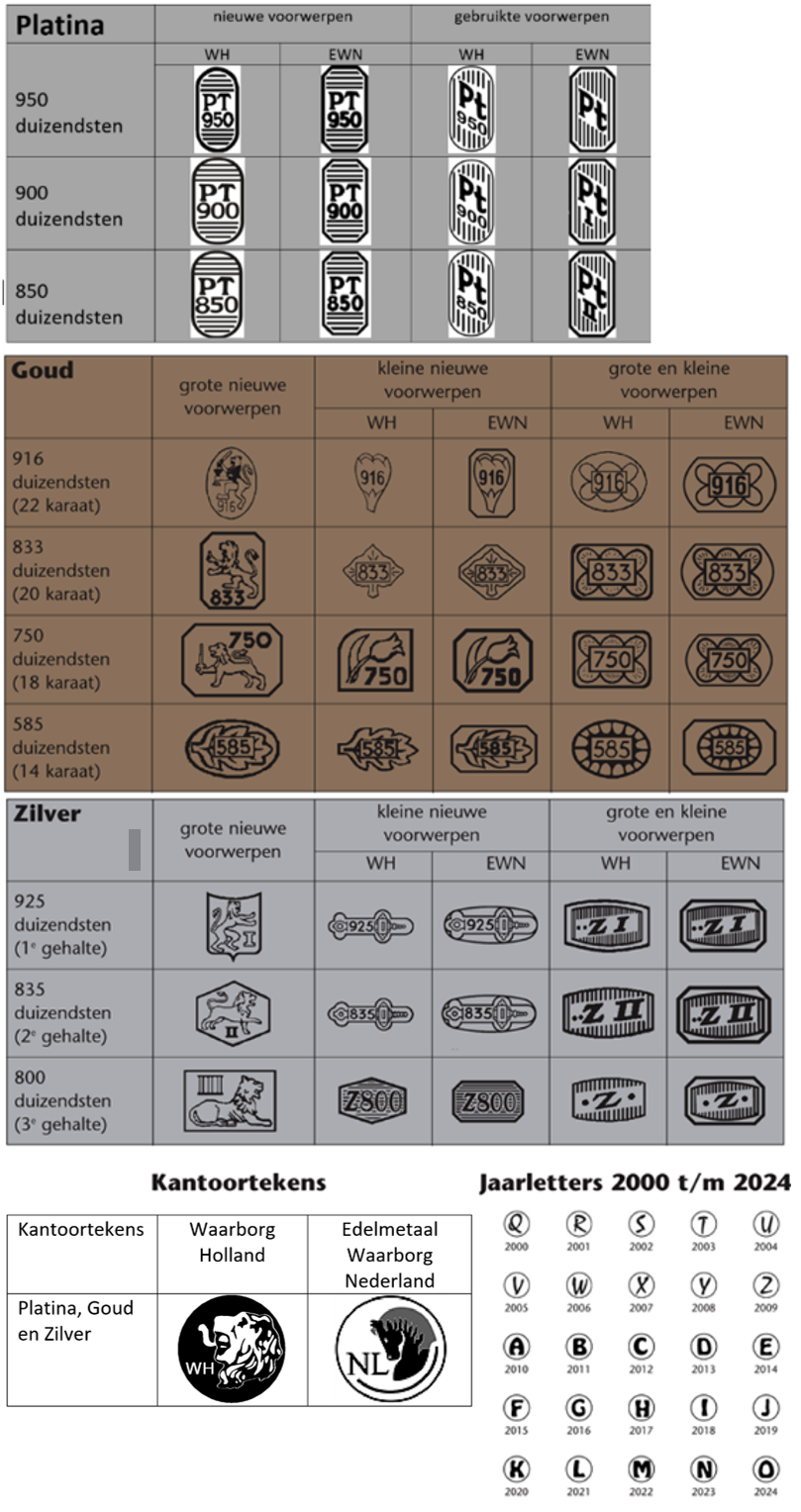
The Dutch hallmarks are recognised in the following European countries:
Austria, Belgium, Cyprus, Denmark1, Estonia, Finland, France, Germany, Greece, Hungary2, Ireland3, Italy, Latvia, Lithuania, Luxembourg, Malta, the Netherlands, Norway, Poland, Portugal, Romania, Slovakia, Slovenia, Spain, Sweden and Switzerland.
1 exporters: please contact us beforehand.
2 exporters: ask WaarborgHolland about the current weight limits.
3 applies only to the finenesses recognised in the country of destination.
The responsibility mark (RM)
The manufacturer or importer of precious metal items must have an RM, which has to be applied to the items manufactured or imported. The manufacturer or importer can apply the RM themselves, or can choose to have WaarborgHolland do it.
In principle, WaarborgHolland can apply the statutory hallmarks to new items only if the responsibility mark is already present in the item, or if WaarborgHolland strikes it at the same time as the hallmark.
Other hallmarks
Common Control Marks
At international level, an agreement has also been in force since 1975, "the Vienna Convention", under which the participating countries accept a common set of marks.
The Convention on the Control and Marking of Articles of Precious Metals is an international agreement between a number of countries on mutual trade in articles made of precious metal.
Members of the Vienna Convention are entitled to strike the "Common Control Mark" (CCM). These CCM hallmarks are recognised by every member state. In addition, a number of countries that are not members do accept the CCM hallmark. These countries regard the CCM hallmark as a "quality mark".
Participating countries: Austria, Croatia, Cyprus, the Czech Republic, Denmark, Finland, Great Britain, Hungary, Ireland, Israel, Latvia, Lithuania, the Netherlands, Norway, Poland, Portugal, Slovakia, Slovenia, Sweden, Switzerland and the United Kingdom. Observer countries: Italy, Serbia, Sri Lanka and Ukraine.
Since March 2010, the CCM has also made it possible to have a palladium hallmark applied.
More information can be found on the website of the Convention.
Applying hallmarks
Hallmarks are applied by stamping or by laser, namely:
- Hand stamping;
- Hand-press stamping;
- Machine stamping (also called counter-stamping);
- Roller stamping;
- Laser marking;
- Triple-punch stamping;
- Final inspection.
I. Hand stamping
When machine stamping is not possible, the items are stamped by hand.
Hand stamping differs from machine stamping in that the marks are struck with a hammer. So-called "pressing" is also a form of hand stamping. Here only muscle power is used. When stamping, the hallmark is preferably struck to the right of the responsibility mark. The gold- or silversmith applies the responsibility mark to unfinished items themselves. The hallmark is struck just as deep.
II. Hand-press stamping
Fragile items, such as enamelled jewellery, watches or hollow items, have to be stamped very carefully to prevent damage.
The required marks are "pressed" in with the utmost care. A gentle rocking movement back and forth with the punch, and muscle power alone, determine how deep the hallmark goes into the item.
III. Counter-stamping
The most widely used form of stamping is counter-stamping. Rings, pendants, necklaces and so on are given 2 marks in a single strike, by machine. This means the hallmark on one side of the item and your responsibility mark on the other.
Counter-stamping has two big advantages:
- It saves time;
- Your responsibility marks are struck free of charge.
IV. Roller stamping
For a few factories, unfinished wedding rings are stamped in a special way. A special roller punch is made for that factory. Stamping takes place in a single rotating movement on a special roller-stamping machine.
The rings are given the hallmark, the responsibility mark and the manufacturer's name at the same time.
V. Laser marking
To prevent damage, the laser is often used for fragile items.
VI. Triple-punch stamping
Large items, such as candlesticks, photo frames and cutlery, can be hallmarked with a triple punch. The triple punch consists of:
- a hallmark;
- the assay office mark;
- the date letter.
These special punches come in both a straight and a knee (angled) model, so that marks can also be struck on the inside of items such as napkin rings and wide rings. A triple mark can also be applied to items by laser. This is recommended for finished items. The punches are available in various sizes. The items submitted must carry a registered RM. A triple mark is not possible in combination with a WaarborgHolland RM. For more information, please contact us.